Six Tips for Low Waste Gift Giving

Gift giving doesn’t have much of a place in my life these days. And when I am giving a gift, it must have a low impact, both on my time and the environment. 

We live in a day and age where we can purchase a staggering amount of ‘stuff’ online and have it shipped straight to our door. Many of us live a short drive away from department stores filled with cheap, mass produced items. Most of us already have too much stuff and with stuff so accessible, I no longer find gift giving in our culture generally a positive, or even thoughtful, thing. It’s something we’re unnecessarily hanging onto and it’s causing us wasted time and harm to the environment. 

Before continuing, I acknowledge that there are cultural, religious and financial elements to gift giving and your situation may be very different to mine. I write here from my own experience.

There are loads of ways we can do better with gift giving. Here are six.

1. “No Gift” Birthday Parties

This is a big one.

If you’re hosting a child’s birthday party (or even an adult’s), particularly with around eight or more guests, consider requesting “no gifts”. I know this may seem quite foreign to some, but when we think about how much stuff comes into our house, I find it staggering we’re still giving party gifts to kids, quite often completely blindly in that we don’t know what the child already has, and what they might want or need. We head to department stores and peruse the aisles hoping for the best and if we’re unsure, we tell ourselves that the receiver can do what they like with it once it’s in their hands (keep or perhaps regift or return)? Bear in mind it’s then up to the parent to deal with any gifts that are unwanted. 

I don’t know about you, but many families I know have precious little free time and I certainly resent the excess time I spend managing unwanted stuff. I cannot tell you how many hours I have sorted Lego, cleaned and advertised items to give away/sell and arranged pick up, or sent items to the Op Shop. I’d rather be going for a walk, reading a good book, spending time with my children; you know, enjoying my life. 

If you decide to ask for no gifts at your child’s party, ensure you explain why to your child, including the benefits to the environment, perhaps they already have plenty of belongings at home and perhaps they are already getting plenty of gifts from close relatives and friends. Explain that the party itself and time with friends is the gift. 

If this isn’t quite right for you, if appropriate, suggest that guests wishing to give a gift purchase a second hand item or voucher for an activity. 

I find it helpful to write on the invite something quite definite like  “No gifts please. Our house is full and <name> will receive plenty of gifts from their family.” I have found that mostly, people respect it. Those who still wanted to give a gift often gave something like a voucher, cash or book. 

If you ever receive an invitation requesting “no gifts”, respect it.

2. Do a Kris-Kringle at Christmas

If no gifts at Christmas is not an option (that’d be my preference!), try a Kris Kringle with those you celebrate with to reduce the amount of gifts. You could go a step further and give second hand or homemade gifts. With so many quality items available from platforms like Gumtree, Facebook marketplace and op-shops, second hand is a wonderful option.

3. Give a Low-impact Gift

Not low impact on the recipient, on the planet! Try to give something that you know is wanted or needed. Opt for quality and sustainable materials, or second hand. A voucher (especially given digitally) that you know they will use and appreciate is a great gift. It’s not appropriate in all situations, but cash is also a great low-impact gift. Or perhaps donate to a charity on their behalf. If you have children and you’re not going to spend the cash immediately, set up a bank account and bank it for them.

4. Talk to your family and friends openly about gifts

If you are receiving too many unwanted gifts from a friend or family member, try to talk to them respectfully and openly about it. You could touch on the difficulty and time required in managing all the ‘stuff’ in your home and how sustainability is important to you. It can be hard for some people to change gift giving habits (which makes me think it is all about them and how they feel about themselves, and not the receiver), but I’ve seen people change due to the wishes of the recipient.

5. Ditch the wrap!

I’m proud to say it’s been many years since I’ve purchased a gift bag or wrapping paper. I’m still enjoying the extra cupboard space! Instead of new wrapping paper or gift bags, reuse paper/gift bags you already have in your home (I’ve noticed you can find used ones at the op shop too). Another idea is wrapping the gift in kids’ artwork, cloth, or old pillow cases. We like to place gifts under a colourful cloth for our children to lift off.

6. Reconsider “Eco-friendly” and “Educational” gifts

Be careful of greenwashing in your attempts to purchase a ‘sustainable’ gift. Is it really environmentally friendly, or is it clever marketing simply making the product look ‘eco’ or ‘green’. Gifts like beeswax wraps or metal straws are only sustainable given if the person doesn’t already have them. Or if they are wanted. 

Don’t confuse ‘educational’ looking gifts as necessarily being a better option either. The stationery that comes home from schools is staggering, much of which winds up in landfill, and it can build up quickly in the home.

I hope the six ideas above have inspired you to change your gift giving habits. Here’s to spending more time with loved ones and less on running around purchasing or rehoming unwanted gifts.

A More Sustainable Visit from Aunt Flo

I love reusable menstrual products. There, I’ve said it. I find them more comfortable, effective, easier to use, and capable of reducing a staggering amount of landfill waste that comes with disposable pads and tampons. I’ve calculated in the approximate seven years that I have been exclusively using my menstrual cup and cloth pads, I have saved over 2,300 disposable pads and tampons from landfill. That’s just me. Imagine what we could achieve if more made the change!

I first heard about reusable menstrual products from a friend in 2013 when she happened to raise the topic. She was quite enthusiastic about them and gave me the name of the brand she used; Scarlet Eve. I didn’t quite ‘get it’ at the time. I thought it was an unusual thing to be so passionate about, but I was definitely intrigued, so I went on to purchase a menstrual cup and a few cloth pads.

I spent around 3 years using them here and there, when I felt like it, in between using my regular disposable products. Once I realised the power these products held to reduce landfill waste, I committed to never purchasing again disposable options. I haven’t looked back.

There is a little bit of learning and unlearning that comes with switching from disposable to reusable. It took me time to gain confidence with using the cup and get into a comfortable routine with washing the pads, but it doesn’t take long to get used to it.

Menstrual Cup
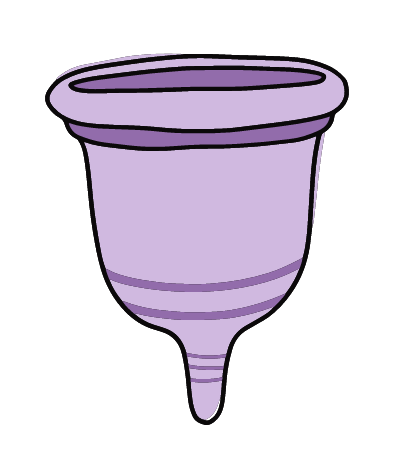
It’s not a difficult learning, but you do need to learn how to correctly insert and carefully remove the cup, for comfort and for function! It does take a few uses or even cycles to get completely comfortable and confident. And that’s ok! When inserted correctly into the vagina, you cannot feel a thing and they cope with more blood than a tampon can, so you can safely leave it in for longer. Super convenient! When you purchase a cup, it will come with clear instructions, but essentially you fold them in on themself to insert and rotate slowly as you insert so it opens up.

If you are not familiar with menstrual cups, here is a link to the menstrual cup I have, but there are lots of options out there. After a few goes, you’ll learn how often you need to empty and reinsert your cup. It’s very individual. I’m heavy in my first three days and in those days, I insert it early in the morning and like to empty it around lunchtime and dinnertime. Then I remove it before bed and use a cloth pad overnight. On the remaining lighter days, I may use cloth pads only, or I may use the cup here and there, depending on what I’m doing.

Are there any cons that come with mentrual cups?
The cons I have for menstrual cups are minor and few. If the cup is not inserted correctly, it can sit too low and be a little uncomfortable (although I have found it usually corrects itself after a while). If the cup is not inserted correctly such that it remains folded, it doesn’t catch the blood effectively and some travels around it through to your pad (I always wear a back up pad anyway because I’m on the heavier side of blood loss and I’d recommend you do the same until you gain confidence with your cup). And, a cup of blood is always going to present a spill risk from the moment you remove it is safely emptied, so you do need to take care when removing the cup. I find if you are paying attention to what you are doing and being careful, you can control this risk! I wouldn’t call the cleaning and sterilising a con. Any product used will require some kind of management (think: tampons require purchasing, ensuring you always have enough with you, and a bin to dispose them in). As the cup only requires 4 min in boiling water to sterilise each day, it’s negligible in my mind when you consider the time required to purchase, pack, unwrap, and dispose of tampons. Not to mention the cost!

How do I clean and sterilise my cup?
If I’m out and about, i just make sure I have clean hands to empty and reinsert my cup and do it so it does not touch any surface at all. I tip the contents into the toilet and flush. If I’m in the comfort of my own home, I give it a quick rinse with tap water between emptying and reinserting. Then I rinse it at the end of the day and boil it for 4 min to sterilise either that night or the next morning before using it again. This is what works for me and you will find a routine that works for you. At the end of use for each cycle, I sterilise it and keep it in a clean, fabric pouch until next month.

I love that once you have the cup in, you are set for the day. You don’t need to take anything with you!

Cloth Pads

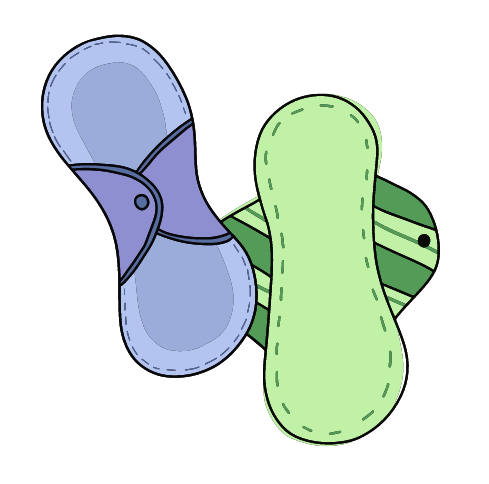
I love my cloth pads. They are more comfortable than disposable pads and there is no awful crinkly sound of the plastic that comes with the latter. I have personally found that cloth pads generate less odour than disposable pads, perhaps because they are more absorbent and breathable.

How many pads will I need?
It took a few cycles for me to figure out what size pads and how many of each I need in my collection and this will vary from person to person. I’d recommend start with a small set as you start out, then complete your set once you know what you need. I have three large ‘uber’ pads for the first three nights, around eight regular pads and a few lighter pads that can be used as liners, which can cope with a little bit of blood.

How do I wash my cloth pads?
Good suppliers of cloth pads with come with clear washing and care instructions. Typically the used pad is placed face-down in a bucket of cold water. It can sit like this until you’re ready to do a load of cold washing (noting it’s generally good to change the water each day if they need to sit there for a few days). I would have classed the blood in a bucket and handling cloth pads in the laundry and hanging on the line a negative in the early days. I felt a little embarrassed about it and I had to remember to hide the buckets away if someone was over. Now I really don’t care. My family and I are used to it and I usually remember to move any ‘moon buckets’ out of sight before visitors come over.

Most of the blood comes out in the bucket soak, after which it can go in a cold wash on a regular cycle and hung on the line. Mine can go in the dryer, but I try to avoid that and mostly completely dry on the line.

How long do cloth pads last?
I’ve only ever used the Scarlet Eve brand so I can only comment on them. These have lasted me years. I’ve only had to replace a small number (maybe 5 or 6) in the last 10 years. Some are starting to look a little weary around the edges now (although are fully functional), so I am expecting to need to replace a few more in the coming couple of years. They are very well made.

What about cons for cloth pads?
Cons include washing them, but it just becomes habit and part of your routine. I don’t think about it anymore. I’ve sorted my collection so I only need to wash 2-3 times during my cycle and I just put them in with other washing and pop straight on the line. I try to use my cup as much as possible on heavier days to minimise pad use. If you’re travelling, you would just need to make sure you can soak, wash, and dry as needed and this has been fine for all of my holidays, but I can see how this could be tricky in some situations.

Have I convinced you yet?
I hope this has helped give some more information on using reusable menstrual products and it has convinced you to make the change as part of your zero waste life! Yes, it is a change and you have to clean and sterilise the cup and wash the pads and you have to put in for the start up cost, but I promise that you can successfully adjust to them and once you do, you will never go back! Buying a cup and start up set of pads pay themselves off within about two years and it is awesome to no longer have to go to the shops to buy disposable pads and tampons!

Lose the Booze

Now, this is not strictly a zero waste-related article, but I’m including it here because for me it aligns with refusing what I don’t need and reducing what I do consume and leading a more meaningful and healthy life; one of the fantastic benefits of zero waste living. Plus, it’s something I really want to write about. So there. Without further ado:

Alcohol is so ingrained in our society that it’s rare to go to any event where there is no alcohol. Even breakfast with friends is no longer safe. Bottomless brunch, anyone?

Like many others, I grew up accepting the prevalence of alcohol in our society automatically. I saw how it was used to celebrate, commiserate, socialise, and ‘relax’. I also saw how it could rip apart families, but despite there being a dysfunctional use of alcohol in my own family growing up, it somehow still managed to seem a wonderfully adult thing to do and I looked forward to being able to have it when I was older. How classy! How delightful! I’d be a real adult when I could come home from work and have a glass of wine! 

I recall no particular regular education or open dialogue about the use and dangers of alcohol further than road and pedestrian safety. And that it was pretty bad to become an  alcoholic. So, go for it, everyone, just don’t get killed on the road, or become an alcoholic, and you’ll be right! 

Like many others, I had my first taste of alcohol in my teens, years before I was legally allowed to drink it. It was funny and experimental and there was no regularity with which I drank, but certainly it became a big part of socialising on weekends in my later teens and we all used it as a way to fit in and ‘be cool’. We didn’t have to be quite as responsible for what we did and said after a few drinks, so how great to navigate those awkward teenage years when you’re maturing from child to adult under the influence of alcohol! It was a bit of fun and a laugh at times, sure, but it could also be pretty stupid and dangerous at times looking back. And despite a handful of nights overdoing it and a few minor teenage dramas, I was lucky there were no major issues or consequences at the time from our drinking. Thankfully there were also plenty of social events without alcohol like exercising, hanging at the beach, and meals out, so there was still plenty of healthy socialising and activities.

I don’t recall it being a big feature or issue in my 20’s, but certainly it was as prevalent as ever at nearly every event, including work functions. Maybe once or twice a year I accidentally overdid it and wound up with a hangover and a few minor regrets, but otherwise I was pretty responsible with it and enjoyed a drink. Cheers and bottoms up!

My 30’s was when my drinking ramped up a bit. After having children, the evening wine became my little reward for getting through the day and helped blur away the messy house and long list of things to do, which I would simply be too exhausted to do at the end of the day. I am a highly organised person who likes my house in order and I struggled with not being able to keep on top of that after having children. Looking back now, I definitely used alcohol to help deal with that. It was a reward, it helped with avoidance, and soothed periods of monotony.

I started looking forward to my evening wine a bit too much and I noticed it. My servings became quite large. And although I kept it to 1-3 glasses by and large and never got ‘drunk’ at home or wound up with hangovers, I wasn’t really ok with it anymore. I would frequently resolve to not drink during the week to only have my hands of their own accord open a bottle of wine at 5pm. I talked about this with many friends and there were two typical responses. The most common response was “if you’re only having one or two glasses, I really wouldn’t worry about it.” Oh, ok, I’d think. The other common response from many was more of a suggestion; “I just don’t drink during the week as a rule. I only drink Fri/Sat.” I always admired those people, but my problem was that I enjoyed the evening weeknight wine way too much for that to stick. If I had some wine left over from the weekend, I’d finish it off over Mon/Tue and then think “oh well, now it’s Thursday and almost the weekend, I may as well open another bottle”. There were the less common responses, which did include a handful of friends in a similar situation to me who wanted to make healthier choices, and others who wholeheartedly supported the evening wine.

I do not believe I had ‘a drinking problem’, depending on your definition. I had a bad habit that wasn’t healthy and I wanted to change. Simple as that. I wanted to change from being a regular drinker to an occasional drinker.

I mulled over this habit for a long time and really started paying attention to how often, how much, and why I would drink. And how it made me feel.

I had a couple of occasions where I did not eat enough food and overdid it with alcohol. Unfortunately one occasion was a work event and the hangxiety that I experienced lasted many weeks and it honestly took me about a year to forgive myself and move on from it. I hated that I acted in a way and said things that I absolutely would not have done if I was sober. I was mortified. This is not about being perfect all the time. This is not about being able to loosen up. There are plenty of other opportunities – daily – in life where we make mistakes and learn from them and learn ways to relax, like reading a book, meditating, listening to some music or cooking, etc. No, we do not need alcohol to help us loosen up or to learn from mistakes. This particular event led to a decision never to drink at a work function ever again. They will be sober from now on. 

I chose not to drink at some boozy social events and I was thrilled to discover that I enjoyed the events just as much – if not more – than if I were to drink. Noted. I loved waking up in the morning with no hangover, no cringing about something I said while a bit tipsy, and no doubt that I was my best self possible. I could happily get on with my day.

It’s quite mad that it is generally not socially acceptable to overdo it with alcohol, yet alcohol, even after a couple of drinks can affect your decision making, particularly around how much more is ok to drink. What’s even more mad is that people can be outcast when they choose not to drink. I am guilty of many years ago, aghast, asking “why?” when a colleague told me she didn’t drink alcohol at all. I’m mortified by that response now. If anyone tells me they do not drink now, I say “good on you!” and I mean it. I have many friends who are so supportive when anyone wants to step away from alcohol. I also have friends who need others around them to drink to justify their own drinking habits. The social event is all about the alcohol for them and they are not particularly happy if you do not drink. And if you’re foolish enough to try to keep up with them, you wind up with your head in the toilet the next day.

During the pandemic, drinking in the evening didn’t really seem ok anymore. Many days were the same and I couldn’t pretend I had an excuse to drink. I wound up taking a few breaks from alcohol. My longest was nine weeks. It was not hard to do and it was quite eye-opening. With no effort, I lost 2-3kg over a few weeks. The most astounding change I noticed was the ability to think more clearly. I made better micro-decisions not only in the evening, but during the day. I found I could more clearly articulate my thoughts and was functioning generally on a higher level. I would have been the only one to notice this; I don’t think it would have been noticeable externally. I was rapt, but also extremely shocked with my finding. I became deeply concerned about what alcohol was doing to so many people in society. What had I been doing to myself all these years with the evening wine? Dulling life around me and my own brain? It certainly wasn’t helping me to perform any better or be a better person, or make better decisions.

Having the breaks from alcohol followed by returning to drinking regularly again gave me an opportunity to pay more attention to the effect alcohol was having on me. Firstly, I noticed if I had wine a few days in a row, my tongue would feel a bit tingly/sore. I’d be more prone to mouth ulcers. After drinking, even one glass, I sometimes noticed slightly elevated anxiety for days after. Alcohol could make my stomach feel a bit sore. Even after only two glasses sometimes, I would wake up the next morning regretting them immediately.

I knew I was getting closer to changing this habit I found myself in.

I started reading. Sober on a Drunk Planet by Sean Alexander was a great read about the insane prevalence of alcohol in our society and the damage it causes to lives. The book is perhaps more aimed at people who drink heavily, but I still found it a valuable book to read. I knew that alcohol could be a ‘risk factor’ for some cancers, but I started paying more attention to some of the research and I learned that alcohol increases the risk of a number of cancers, including mouth (30% of mouth cancer cases in Australia are caused by alcohol (Pandeya et. al., 2015)), pharynx, larynx oesophagus, breast, stomach, liver and bowel cancers. One of my friends, while in her 30’s, had to have pre-cancerous tissue cut out of her tongue and was told by the specialist to no longer drink alcohol or she would be putting herself at risk of mouth cancer.

When alcohol is ingested in your system, one way it is metabolised by the body is by the enzyme alcohol dehydrogenase, which creates acetaldehyde and this, my friends, is toxic (suspected carcinogenic). Although acetaldehyde is transient and is metabolised further by the body into other compounds, it is believed that it’s there long enough to increase the risk of cancer. Alcoholic beverages may also contain a variety of carcinogenic substances that are introduced during fermentation and production (National Cancer Institute, NCI). The link with cancer has now become my biggest motivator to cut down on drinking. My other motivators are to think more clearly and make better day to day decisions, to spend my time (and money) on things and experiences that matter and that are meaningful. I want sober experiences in life. Not blurry tipsy ones. 

Whilst much research tries to look for health benefits of alcohol, I’m yet to find anything of note. In fact, a recent study could only demonstrate minor health benefits for those in their 70’s and that was with moderate intake within the recommended limits (I promise I will slot in the reference for this once I find it again!). So, if it helps, NHMRC guidelines tell us that healthy adults should drink no more than 10 drinks per week and no more than four standard drinks on any one day.  I think it’s important that we don’t interpret this meaning that these are healthy amounts. There is no healthy amount. It’s safest to assume alcohol has no health benefits. 

I’m rapt to learn that the Sober Curious movement is increasing in popularity and I hope that as my children approach legal drinking age, alcohol is not something that they look forward to. I hope I can educate them to critically evaluate why they are drinking whenever they do and to enjoy it from time to time if that’s what they wish to do, but to treat it as the drug that it is and to not become blase about it. I want them to know about the negative impacts to their health, about repercussions that can occur from drinking it, that it can affect people differently and to practise saying “no thanks, I’m not drinking today/tonight, I…..

…..am having a break from alcohol for health reasons”

…..have something important on tomorrow”

…..don’t drink very often, it doesn’t agree with me”

…..prefer to experience life sober”

….or WHATEVER they want to say. I want them to learn that people who pressure them to drink to justify their own drinking or to ensure there is no one sober around to judge/witness their drunk antics are perhaps not worth hanging around. If they’re sober, they can always exercise their best judgement and will likely avoid the serious regret and negative impacts that can come with drinking.

I want them to know it’s ok to not go to an event if there will be copious drinking there and they just don’t want to be a part of it.

I want them to know that life can be just as fun and fulfilling with a full range of experiences without alcohol. I would say it is more so.

Now that I’m drinking less, I want it less. The more I drank before, the more I drank. What kind of false reward feedback system is alcohol creating in our minds, particularly when we repeatedly wake up with regret and many of us want to drink less. 

I am very happy to report that I have kicked the evening wine habit and now no longer (or very rarely) even want it in the evening. I am completely at peace with choosing to have a few wines at the occasional event and I enjoy them when I do. 

On the zero waste front, my reduction in alcoholic beverage consumption means I am sending much less through the high resource-requiring recycling process, and probably less to landfill too with the odd bits of packaging and lids that don’t make it through the recycling process.

Are there any changes you have been wanting to make to lead a more healthy and meaningful life, and perhaps reduce consumption in the process? Go for it! You have nothing to lose.

Here are some interesting ABC articles related to drinking:

https://www.abc.net.au/news/health/2021-06-08/alcohol-women-in-middle-age-and-cancer-risk/100150220#:~:text=Because%20she%20drinks%20every%20day,box)%20are%20also%20more%20likely.

https://www.abc.net.au/news/2019-07-13/should-cancer-warning-labels-be-placed-on-alcohol-products/11296166

National Cancer Institute (NCI): Alcohol information

https://www.cancer.gov/about-cancer/causes-prevention/risk/alcohol/alcohol-fact-sheet#how-does-alcohol-affect-the-risk-of-cancer

National Health and Medical Research Council: Alcohol information 

https://www.nhmrc.gov.au/about-us/publications/australian-guidelines-reduce-health-risks-drinking-alcohol

https://www.nhmrc.gov.au/health-advice/alcohol

Pandeya, N., Wilson, N.F., Webb, P.M., Neale, R.E., Bain, C.J., and Whiteman, D.C. (2015) Cancers in Australia in 2010 Attributable to the Consumption of Alcohol. Australia and New Zealand Journal of Public Health.39(5), 408-413 [Online access here]

Coffee: I went black and I’m not going back

Wherever you go, you see people drinking coffee. I can’t think of a typical outing that I go on where I don’t see people drinking it.

In efforts to simplify my life and follow the Zero Waste Living principles (Refuse, Reduce, Reuse, Recycle, and Rot) I challenged myself to question my coffee drinking behaviours and looked for opportunities to make the choice to drink coffee more environmentally friendly. 

I enjoy coffee two, sometimes three, times a day. The afternoon one with a slice of a homemade goodie, thanks very much. My coffee habits started with a white coffee, one sugar. Over time, the volume of the coffees I made myself seemed to increase (cue searching for the largest mug in the kitchen cupboard and ordering a ‘Sunday latte’ while out with friends). What started as a once or twice a day small coffee had become two or three large ones. 

It was early 2019 when I officially decided that I would – never again – use a single-use, disposable coffee cup. I have a reusable cup to use if I order a takeaway, or I choose to sit in a cafe with a glass or ceramic mug, or I make one at home.

If I am out and feel like a coffee and don’t have my cup and don’t have time to sit in a cafe, I simply don’t have a coffee. 

After I ditched the disposable cup for good, I considered other ways I could reduce the impact on the environment with my coffee consumption (as I’m not quite ready to give it up for good). I switched back to a small size latte and stuck to two a day. Then there was the sugar. That was surprisingly easy to cut out of my coffee and I merrily made that switch cold turkey. That’s two teaspoons of sugar a day, or about 3.5kg of the stuff a year, that I have removed from my diet.

Next, and this took a bit longer, was challenging the cows milk in my coffee.

The damage the production of moo-milk does to the environment has long been known. Moo-milk requires a massive amount of land and water to grow the cows and their feed, which are burped out in the form of methane, a greenhouse gas. For this reason (not ignoring dairy allergies), plant mylks have really taken off. After sitting on this for a while and considering the negative environmental effects of a lot of plant mylks themselves, I decided to go cold turkey and simply made myself a black coffee and hoped for the best. Well, I can’t believe I had procrastinated with this change for so long as I was supremely surprised to find that black coffee is a lovely drink and I feel that I am missing out on nothing by cutting out the milk. I haven’t looked back! If you’re thinking about it, just do it! For what it’s worth – the feeling in my mouth after drinking a black coffee is much nicer than when I had it with moo-milk. It seems to sit in my body a bit better.

That’s around 100L of cows milk I have removed from my diet each year. And I’m just one person!

It is quite empowering to finally change a habit. There is an almost magical feeling that comes when you shift from repeatedly thinking about doing something to actually doing it. It’s quite liberating. I firmly believe that the more you change in your life to live by the zero waste principles, the more empowered you feel, the more you can uncover your true values and feel confident in the decisions you make. 

I hope I’ve inspired you to critically look at your coffee drinking habits and see where there may be some opportunity to be kinder on the environment. There is the receptacle you drink it in, the amount you’re drinking, the sugar, and the milk that you could consider making changes in. The next step is to consider where and how your beans are grown and that is a topic for another day!

Zero Waste Mopping

Different kinds of mops line the shelves of the shops, many of which require the purchase of replacement heads once they wear out. These heads often come in plastic packaging and may themselves be made from or contain plastic parts. Some brands of mops even use attachable disposable wipes (“…and this is the best part – when you’re done, just toss it!” says the advertisement for one mop as they throw the single-use wipe into the bin*). It’s no surprise that a common item seen on naturestrips in hard rubbish are mops. I suspect many are broken, yes, but I wonder if people take the opportunity to buy a different kind of mop instead of the replacement head once their last one is spent? It can be confusing to go back to the store years later to find the right replacement head.

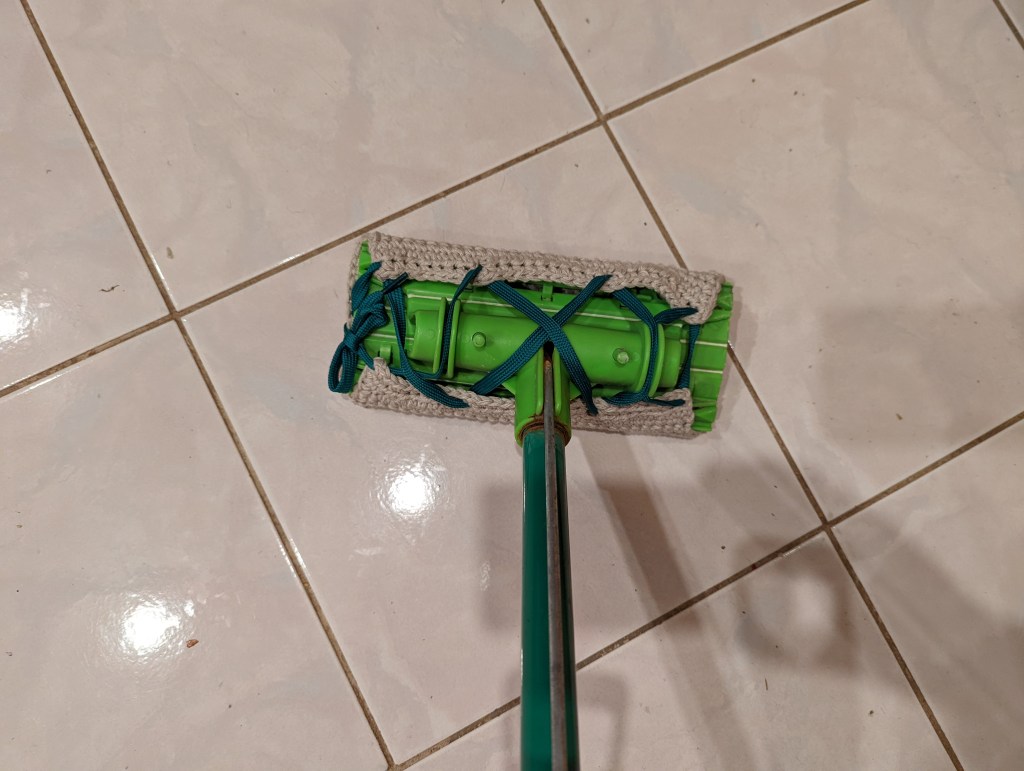
I recently used up my last sponge head for my Sabco sponge mop that I purchased years ago. I started to look into zero waste alternatives to buying the replacement sponge, which comes in plastic packaging and has a plastic bracket attached to it with four small plasic screws that come in another small plastic packet within the main packaging.

I searched online for ideas and didn’t find one specifically for my mop type, but I did come across this great article (take a look at Tammy’s website and blog – it’s rad!) and some other ideas that got me thinking. I decided to give a crochet mop head a go.

I had some leftover thick cotton yarn at home, so crocheted up a large version of my dish scrubbers (these babies). After struggling for ideas on how to attach the scrubber, I reminded myself that sometimes the solutions for zero waste are simple, so I waited for an idea to come. Bingo – tie it on shoelace style with an old shoelace. It worked a treat!


I know we don’t all crochet or sew, but there are some other simple ideas in the article linked above and I hope this provides a little inspiration to re-think your next automatic purchase. Do you really need it? Is there something you already have (or could make with existing materials) that can do the job? Could you find it second hand? If you do need to purchase it, select the most environmentally friendly option at the shops.

The best option in this case would be no mop at all and for what it’s worth, I did actually get down on my hands and knees and wipe down the floor with rags from our old, unusable clothes while I pondered my mop solution. It was perfectly fine for small areas and spot cleaning, but I didn’t really fancy doing it through the whole house. I do recommend trying it though as you may find that is a perfectly fine solution for you (just fold up an old towel to kneel on!).

*I REALLY think we are going to look back on this kind of mentality in the near future and see that it is completely, well, MENTAL

It’s the Very Yeast I Could Dough – Challenges in the Kitchen

The kitchen. The place in our homes where we have perhaps the greatest potential to reduce our household waste.  

And the place where I struggle to do this the most. 

When I started on my Zero Waste living journey, I confidently and enthusiastically dived into tackling personal care, clothing, household and cleaning and ‘out and about’ quite easily. I have certainly made loads of big-impact, waste-reducing changes in the kitchen, but why has this stalled a bit for me and why has this area felt a bit harder to progress?

Firstly, I have three other family members to consider who all have their own needs and wants. My husband, whilst amazingly supportive and adoptive of many of my Zero Waste ways, still lives his own life and makes his own choices. 

Secondly, whilst Zero Waste living is most definitely time- and cost-saving overall, I’ve personally found that the kitchen is not the place where this saving usually comes from – so far. I need to make an extra trip out of the way to get to the bulk store and buying in bulk is not always the cheaper option. I do not always have the time to make meals/ingredients from scratch. And sometimes my attempts to make things with reduced waste from scratch is a complete failure and I am put off from trying for a while. And meal times are usually a time where you’ve got to be quick; at dinner time, it’s the pointy end of the day where work is being wrapped up, school bag contents are being strewn across the house, after-school activities are attended, homework needs to be done, showers had and books read (and gosh darn it, where did I put my glass of wine?). It’s not always possible to cook from scratch. 

Thirdly, sometimes there simply isn’t an unpackaged option available. 

So, what’s my point and what have I learned to address this?

My point is that it’s not always easy. Today might not be the day you make that vegan curry with ingredients from the bulk store. Maybe that’s tomorrow or next week or next month. It’s ok. It can take time to make changes. And sometimes there are setbacks. Continue trying while being kind to yourself and your ideas will happen! 

Also, it’s not your fault if there is no package-free option available! 

I’ve learned that rethinking meal planning helps (we can be such creatures of habit). Is there a similar meal that could be made that uses less packaged ingredients? Or are there any ingredients that could be replaced by an alternative that comes without packaging? Does this particular recipe, with its many ingredients and fiddly method, still have a place in your zero waste life? 

Instead of being overwhelmed by ‘all the things’ at once, tackle one thing at a time. After recently feeling frustrated with my lack of progress in the kitchen, I decided to simply think about what one or two items we regularly buy that come in packaging that I could realistically replace by making from scratch using ingredients I could buy in bulk (or low packaging).

I came up with pizza bases and wraps. Both of these we would usually buy pre-made in packaging. After a little bit of recipe searching, I found pizza base and tortilla wrap recipes that the whole family loves. And I’ve now successfully reduced our packaging waste for these items – the plastic packets they come in, as well as those little oxygen absorbers. Did these recipes work the first time around? Nope! The first pizza bases I made were way too heavy and got the thumbs down from the entire family. The first tortilla wraps I made were ‘ok’, but a bit too soft and floury and the family ‘preferred the store-bought ones’. I was pretty lucky that the second recipe attempt for both got big ticks! These are waste-saving and cost-saving changes (not to mention delicious!). The pizza bases are pretty quick to make, but I find the rolling and cooking time for the tortillas adds up when you’re making 10, although I think I’ll get faster and I will soon try making them ahead of time.

Sometimes it can take a little bit of planning, research and effort to initially make a change, but once you’ve found something that works, you adopt it and no longer need to think about it. The hard work is over and it is just the norm. Then you can move on to the next change when you’re ready. 

For anyone who is interested, these are my new favourite pizza base and tortilla wrap recipes! Whatever you’re planning to try out, try to get your ingredients from your local bulk store, or find low-packaging options at your grocery store with recyclable or compostable packaging. 

Happy cooking. Now where did I put that wine…….

How do you make a hankie dance?……Put a little boogie in it!

Tissues – argh! How I used to use one without thought! Whilst tissues made from recycled material are increasingly available, most other tissues are made of virgin fibers from trees like eucalyptus, spruce, fir, aspen and maple. These are designed to be used once, then thrown in the landfill bin. Not only are these tissues made from trees, but then there is also the cardboard box or plastic packet.

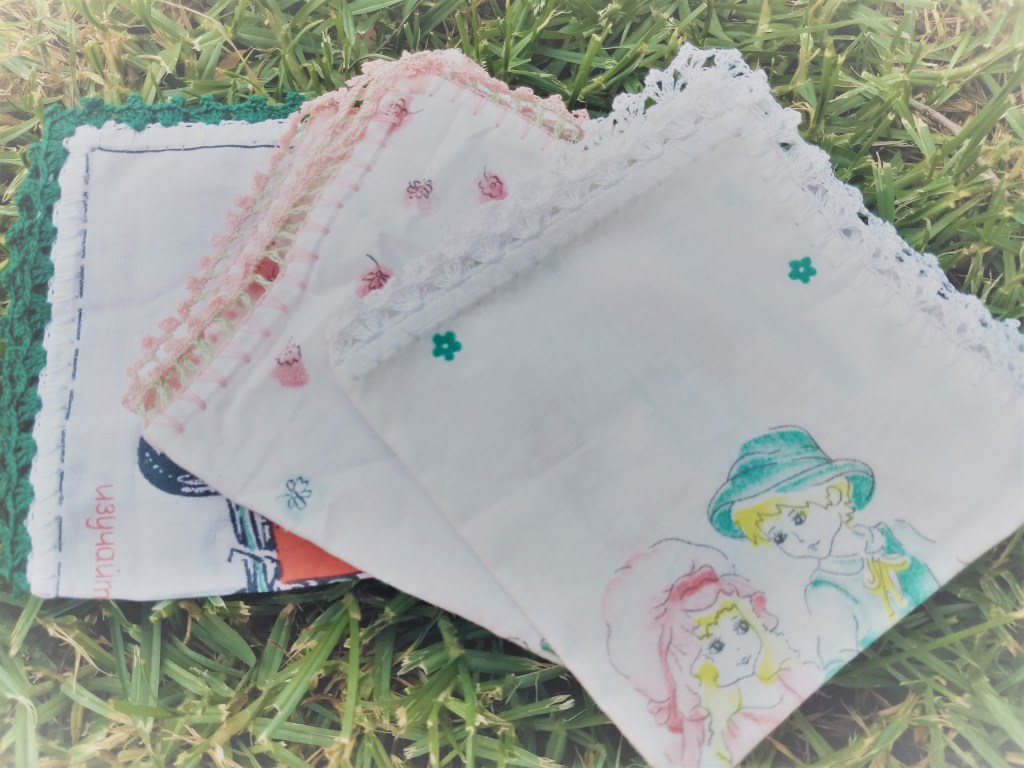
Three hankies I purchased from a vintage market recently. I was happy to see they were package-free!

I found several online articles (e.g., Packaging Europe) claiming that Kleenex was planning to remove the plastic collar opening on their tissue boxes, which would see a reduction in plastic to the equivalent of 8 MILLION plastic bottles a YEAR. This is staggering. As far as I’ve seen, those plastic collars are still on the boxes in my local area.

I very rarely use tissues these days. I challenge you to think of any use for them you couldn’t substitute with a hankie, or other washable, reusable, up-cycled fabric (think: old cut up pillow cases, etc.). When I decided to switch from tissues to handkerchiefs, I was happy to realise I actually had quite a few hankies at home to get started. Luckily my husband was raised to always have a neat, ironed hankie in his pocket (they are far more crumpled these days!) and my boys were also accustomed to having one in their pocket. I started keeping a hankie in my bag every time I went out, including to work, and found I never needed tissues. Especially when I started taking a cloth napkin with me too. 

These days paper tissues are reserved for when one of us has a cold (not very often) and occasionally the kids will grab one instead of a hankie, but I plan on cutting that out soon when I finally get around to making a big stack of hankies out of an old doona cover that was given to me. I had a failed attempt at the hem on my sewing machine last time (cue multiple burning smells and the thing sewing on its own!), so I will try an overlocked edge next!

Disposable paper napkins are also easily replaced with a reusable cloth napkin. It doesn’t take up much room in your bag or pocket when you’re out and about! And you get used to saying ‘no napkin, thanks!’.  In the home, we have long preferred to use face washers at the dinner table to wipe our hands and faces. So much more effective than a throw-away paper napkin! We keep a stack of dark blue face washers in a kitchen drawer, rinse and hang on the back of a dining chair until they need a wash. Super easy! I was frustrated at buying a pack of disposable napkins when entertaining a couple of months ago. I simply didn’t have enough cloth napkins and face washers to offer. Time to get sewing and upcycle some more fabric!

Hopefully I’ve inspired you to ditch single-use tissues and napkins. I’ve certainly got myself motivated to take the last step and say goodbye to them for good!

I’d love to hear from you if you have any great tips on how to say goodbye to single-use tissues or napkins!

Beginnings…

We all have our own story of how our awareness grew around the negative impacts of the waste we produce and how our desire for change came about. Perhaps you were lucky enough to have been raised living Zero Waste, or perhaps you have recently in adulthood commenced your Zero Waste journey. Wherever we are at, it’s important to encourage each other with kindness and share ideas.

Perhaps some of you can relate to how I came to change some of my wasteful ways…..

Childhood

I grew up with an appreciation for and love of nature and understood the importance of caring for it. As a child, I knew how to compost, separate our rubbish for recycling, landfill, or green waste, and we generally didn’t consume/own large amounts of unnecessary items. However, that was where the efforts ended. Like many others did and still do, we sent single-use items off to landfill, used plastic cling-wrap to cover food and for many years used plastic bags to collect groceries and fruit and vegetables. When I moved out of the family home and into my own, I promptly set up a compost bin, put a ‘no junk mail’ sticker on the mailbox, gave myself a pat on the back and continued my ‘environmentally friendly’ ways. 

Having children 

After having two children, I became increasingly aware of the waste we were generating. We were just one average family trying to do what we could to not be wasteful and separate our rubbish, yet we were still generating an 80L bin of landfill each week and a 240L bin of recycling every fortnight. The scale of what was being generated across the community, and indeed the planet, started to concern me. 

Perhaps it was having children and the desire for sustainability for the next generation on my mind. Perhaps it was the tide of ‘things’ that seemed to endlessly flow into our house after having children (well-meaning gifts, samples, things we bought that we thought we needed for a baby or toddler) and my increasing resentment for the amount of my time that their management required. I cannot say exactly what the catalyst was, but there was a growing awareness and many lightbulb moments that were about to lead to positive change.

In one of my ‘lightbulb’ moments, I was standing in my laundry and staring at the giant empty plastic tub of ‘Earth-friendly’ laundry liquid wondering if it really gets recycled when I put it in the recycle bin and what energy and resources are required to generate and then recycle this tub? What pollutants are released into the environment in these processes? This is just one tub, one person, one laundry. How could this product possibly be ‘Earth-friendly’? How is this ok? The questions and concerns around the impact of our consumer-driven and waste-producing society were reeling in my head, but growing was the firm belief that there. Must. Be. A. Better. Way. 

The world of Zero Waste

I started looking into ways to reduce waste and – wow – a whole new world opened up! The world of Zero Waste. There were many items in the home I simply didn’t need (a cupboard full of various cleaning products and plastic cling film for example), so many disposable products that could be replaced with more sustainable alternatives (bye-bye single-use tampons and menstrual pads, sayonara plastic produce bags!) and alternatives at the shops and surrounds (filling my own reusable jar with popping corn? Yes please! Using olive oil as a night moisturiser for amazing skin? Bring it on!). 

The two biggest game-changers for me were purchasing Bea Johnson’s book “Zero Waste Home” and discovering local bulk food stores that I had previously not known existed.

Now

Although I’ve been making changes for around four years now, I still have a long way to go, have a lot to learn and am very much on the Zero Waste journey myself. I am far from eliminating plastic waste in my life, but I have reduced our family’s waste dramatically* and I’m keen to continue to find ways to reduce my waste, including my recycling. 

Change to Zero 

Starting ‘Change to Zero’ has been bubbling away in my mind for a while, spurred on by the desire to raise awareness and start conversations about reducing household waste and living more environmentally friendly in the day-to-day. We can make a big impact by some pretty simple changes and there is so much we can do right now!

So many of us buy wasteful things that we don’t need because they are in the mainstream; they are at the shops in front of us and we see many others purchasing them, so we do so without thought. If more people start Zero Waste living and make positive changes, awareness will increase and the change to more sustainable living will accellerate. I hope to be one voice of many that contributes to the switch to Zero Waste living.  

For what it’s worth

Zero Waste living has brought meaning and an enjoyable simplicity to my life. I have gained more time for the important things, and saved money. And, it doesn’t cost anything; nothing needs to be sacrificed. To quote Bea Johnson in her book Zero Waste Home, “Zero Waste does not deprive; on the contrary, through Zero Waste, I have found a sense of meaning and purpose. My life has been transformed – it’s based on experiences rather than stuff, based on embracing change rather than hiding in denial”. I have found this to be my experience also. 

*Our 80L weekly red bin has gone from ~100% full to ~20% full most weeks and we produce none to very little waste when we are out and about as we tend to go completely zero when we are out or bring any small amounts of waste home to sort. We are still working on the recycling and that is a little harder to measure as that fluctuated fortnight to fortnight a little anyway, but it is dropping. I’ve got some more work to do!